
A nine-judge Supreme Court bench has reserved its order on petitions related to discrimination against women at religious places, including the Sabarimala temple, and the scope of religious freedom.
The Supreme Court has stated that roads cannot be blocked for religious activities and that while religious denominations have autonomy in worship, the government can interfere if secular activities are affected.
A nine-judge Supreme Court bench has commenced hearing on petitions related to discrimination against women at religious places, including the Sabarimala temple, and the scope of religious freedom across faiths.

The Supreme Court of India has stated that religious institutions must have structure and norms for their functioning, emphasising that the right to manage a religious institution does not imply an absence of order.
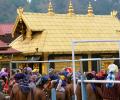
The Travancore Devaswom Board (TDB), managing the Sabarimala temple, argued in the Supreme Court that religious beliefs should be judged subjectively by the community, as the court hears petitions related to discrimination against women at religious places.
The Supreme Court of India has dismissed the use of information from 'WhatsApp University' as evidence in a case concerning religious freedom and discrimination against women at religious sites, including the Sabarimala Temple.
The Shabari story in the Ramayana found mention before a nine-judge constitution bench of the Supreme Court on Wednesday while hearing petitions related to discrimination against women at religious places, including the Sabarimala temple in Kerala.

The Centre has informed the Supreme Court that the restriction on women of menstruating age entering Kerala's Sabarimala temple is a matter of religious faith and denominational autonomy, falling outside the purview of judicial review. Solicitor General Tushar Mehta argued that courts should not apply 'secular standards of reason' to religious practices.

The Supreme Court of India has emphasised the importance of open access to all temples and 'maths' for everyone, warning that excluding any denomination would negatively impact Hinduism and divide society. This statement was made during hearings on petitions related to discrimination against women at religious sites and the scope of religious freedom.
The Supreme Court of India has observed that the practice of excommunicating Parsi women for entering into interfaith marriages is prima facie discriminatory, emphasising that the right of conscience is a birthright.

The Supreme Court has announced that a nine-judge bench will begin final hearings on petitions related to discrimination against women in religions, including the Sabarimala Temple case, starting April 7.
The Supreme Court of India is hearing petitions related to discrimination against women at religious places, including the Sabarimala temple in Kerala, and the scope of religious freedom practised by multiple faiths.
The Supreme Court of India questioned the Centre regarding the eligibility of non-devotees to challenge the customs of the Sabarimala temple in Kerala, during a hearing on religious freedom and discrimination against women at religious sites.

The Supreme Court questioned the chief priest of the Sabarimala Ayyappa Temple regarding the constitutionality of preventing believers from touching the deity, during hearings on discrimination against women at religious sites.

The Supreme Court of India has voiced concerns about the potential consequences of individuals questioning religious practices in constitutional courts, warning it could lead to the fragmentation of religions and civilisation. A nine-judge Constitution bench is hearing petitions related to discrimination against women at religious places and the scope of religious freedom.

He said that just as there are rules related to religious conduct in mosques and churches, there are also traditional rules in Hindu religious places.

President Vladimir Putin attended an early Wednesday Russian Orthodox Christmas service and hailed his troops' 'holy mission' to defend Russia, pairing the ceremony with a holiday address on unity, charity and support for the armed forces.
Describing the act as the 'grossest kind of indiscipline', the Supreme Court on Tuesday dismissed a former Christian officer's plea challenging his termination from the armed forces, after he allegedly refused to participate in regimental religious activities at the sanctum sanctorum of a temple at a place of his posting.
The share of the Hindu population declined by 7.8% to 78.06%.
In contrast, the share of the Muslim and Christian populations increased by 43.15% to 14.09%, and by 5.4% to 2.36%.
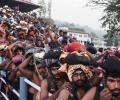
The top court said the old practices of "human sacrifices" and 'sati' amounted to murder under law and could not be saved on ground of "essential religious practice".
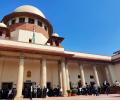
The Supreme Court on Monday agreed to consider listing for urgent hearing the petitions challenging the constitutional validity of the Waqf (Amendment) Act, 2025.
A fresh plea has been filed in the Supreme Court challenging the constitutional validity of the Waqf (Amendment) Act, 2025, claiming it was a "blatant intrusion" into the rights of a religious denomination to manage its own affairs in the matter of religion. The plea, filed by Samastha Kerala Jamiathul Ulema, argues that the amendments would distort the religious character of Waqfs and irreversibly damage the democratic process in their administration. Several other petitions have been filed in the apex court challenging the validity of the bill, including those by Congress MP Mohammad Jawed, AIMIM president Asaduddin Owaisi, and AAP MLA Amanatullah Khan.
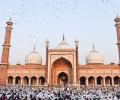
'Only because of the absence of a dedication record in writing, how can such properties be treated as located on misappropriated government land?'
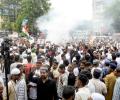
Congress MP Mohammad Jawed and AIMIM president Asaduddin Owaisi have challenged the validity of the Waqf (Amendment) Bill, 2025 in the Supreme Court, arguing that it violates constitutional provisions. The petitions claim the bill imposes arbitrary restrictions on Waqf properties and their management, undermining the religious autonomy of the Muslim community. They also allege that the bill discriminates against Muslims by imposing restrictions not present in the governance of other religious endowments. The bill was passed in the Rajya Sabha and Lok Sabha, with the petitioners arguing that it introduces limitations on the creation of Waqfs based on the duration of one's religious practice, mandates inclusion of non-Muslim members in Waqf administrative bodies, and shifts key administrative functions to government officials, thereby diluting the autonomy of Waqf management.
The Supreme Court of India will likely hear a batch of petitions challenging the constitutional validity of the Waqf (Amendment) Act, 2025 on April 15. The Act, which came into force on April 8, has been met with widespread criticism from various stakeholders, including politicians, the All India Muslim Personal Law Board (AIMPLB), and Jamiat Ulama-i-Hind. They argue that the law is discriminatory and violates the fundamental rights guaranteed under Articles 25 and 26 of the Constitution. The petitions allege that the amendments give the government more control over the administration of Waqf, effectively sidelining the Muslim minority from managing their own religious endowments.
Using the same methodology as the EAC-PM study, the fastest-growing religious population is, in fact, the Buddhists. The Buddhist population increased by over 1,600 per cent between 1950 and 2015.

A three-judge Supreme Court bench will hear petitions challenging the constitutional validity of the Waqf (Amendment) Act, 2025, on April 16. The petitions, including those by politicians and the All India Muslim Personal Law Board (AIMPLB) and Jamiat Ulama-i-Hind, were filed in the top court challenging the validity of the newly-enacted law. The Centre has filed a caveat in the apex court, seeking a hearing before any order is passed.
'They have to prove the credibility of their talk; whether they want to focus on the secular face of India, whether they want to focus on democracy and above all freedom of an individual to practice his or her religion.'
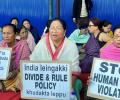
Fresh clashes broke out between people belonging to Zomi and Hmar tribes in Manipur's Churachandpur district, hours after a peace settlement was reached between the apex bodies of the two communities. The Zomi Students' Federation imposed a shutdown in the district after a group of men tried to take down a flag of a Zomi militant outfit. Several persons were injured in the clashes. Meanwhile, MLAs and tribal organisations appealed for peace, urging the administration to take necessary measures to restore law and order.
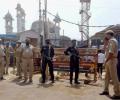
A plea was filed in the Supreme Court on Wednesday challenging the constitutional validity of certain sections of the Places of Worship (Special Provisions) Act 1991, saying that it "barefacedly violates" the principles of secularism and rule of law.

On February 1, grappling with the intractable issue of the AMU's minority status, the top court said the 1981 amendment to the AMU Act, which effectively accorded it a minority status, only did a "half-hearted job" and did not restore the institution the position it had prior to 1951.
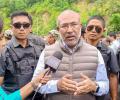
The Supreme Court on Friday directed the Manipur government to apprise the apex court-appointed committee of the steps taken to secure places of public worship in the state where ethnic clashes have claimed more than 170 lives since May.
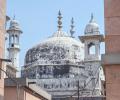
The Places of Worship Act is 'An Act to prohibit conversion of any place of worship and to provide for the maintenance of the religious character of any place of worship as it existed on the 15th day of August 1947, and for matters connected therewith or incidental thereto'.

The plea, filed by a religious guru based in Mathura, Devkinandan Thakur, has challenged the constitutional validity of Sections 2, 3, and 4 of the Places of Worship (Special Provisions) Act 1991, stating that it offends Articles 14, 15, 21, 25, 26, 29 of the Indian constitution and violates the principles of secularism and the rule of law, which is an integral part of the Preamble and basic structure of the Constitution.

The court has 'only decided on the issue of proof and not faith', a single bench of Justice Gautam Patel said and dismissed the suit initially filed by Khuzaima Qutbuddin soon after his brother and the then Syedna Mohammed Burhanuddin passed away in January 2014 at the age of 102.

It said AMU is not and cannot be a university of any particular religion or religious denomination as any university which has been declared an institution of national importance cannot be a minority institution.

What was once a solemn Vedic ritual is today a celebration for the entire extended family. And why not? With families living in distant cities, even continents, weddings are seen as an occasion for cousins and uncles to congregate under one roof for two or three days, observes Ambi Parmeswaran.
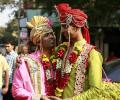
Terming the petitions seeking legal validation of same-sex marriage as one which reflect an "urban elitist" view, the Centre has told the Supreme Court that recognition of marriage is essentially a legislative function which the courts should refrain from deciding.

Grappling with the intractable issue of Aligarh Muslim University's minority status, the Supreme Court said on Thursday the 1981 amendment to the AMU Act, which effectively accorded it a minority status, only did a "half-hearted job" and not restore to the institution the position it had prior to 1951.

A bench comprising Justice Ashwani Kumar Mishra and Justice Ashutosh Srivastava passed the order on the public interest litigation filed by one Sudhir Kumar who argued that the film, if released/broadcast, is likely to create hatred amongst different religious denominations and thereby destroy the secular fabric of India.
